Free Shipping on orders over R3,999. T's&C's Apply.

FREQUENTLY ASKED QUESTIONS
Whether it is for your business or your home, choosing a high pressure cleaner starts with the application: the right machine is the one that meets the cleaning task it is bought for. The brand matters, and so does the supplier behind it - one that provides after-sales service, holds spare parts and offers technical back-up.
These are the questions we are asked most. If yours is not here, please contact us - we would like to know, so we can add it to the list.
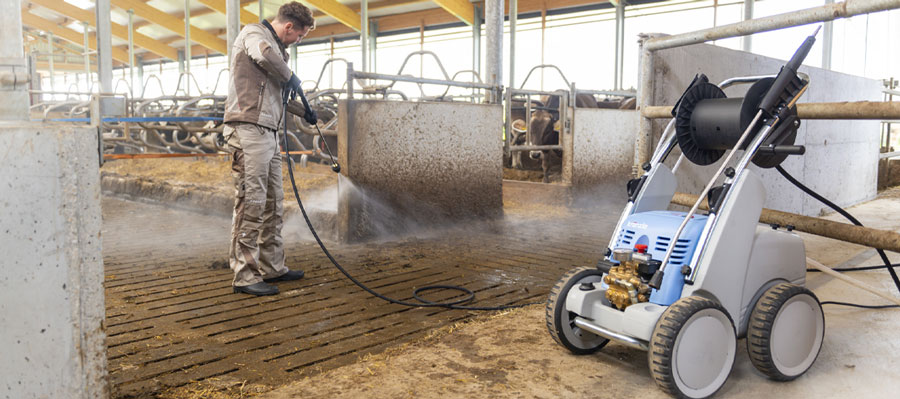
Choosing a high pressure cleaner
What is the cleaning wheel?
Every cleaning task is done by a combination of six factors. We show them as a wheel, because changing one means the others have to change to make up for it.
Washing dishes by hand is the easiest way to picture it:
- Water - the water in the basin.
- Time - how long is spent cleaning each item.
- Chemical - the dishwashing liquid.
- Mechanical action - the cloth, brush or sponge.
- Heat - whether the water is hot or cold.
- Labour - the person doing the work.
Wash in cold water and the heat slice shrinks. To make up for it you use more dishwashing liquid, a rougher sponge instead of a cloth, and it takes longer. Changing one factor meant adjusting three others.
The same principle applies to high pressure cleaning. A cold water machine used on oily soiling needs more chemical, or more time and labour. A hot water machine generally removes greasy soiling faster than a cold water machine. A rotating nozzle such as the Dirtkiller removes caked-on soiling faster than a standard flat-jet nozzle, and a high pressure cleaner applies far more mechanical action than cleaning by hand.
What are the benefits of a high pressure cleaner?
- Less water: an open hose pipe sends most of its water straight down the drain. A high pressure cleaner puts a smaller volume of water to work at pressure.
- More mechanical action: the high pressure jet does far more work on the surface than a brush, cloth or scourer by hand.
- Rotating nozzles for stubborn soiling: a rotating nozzle such as the Dirtkiller breaks up caked-on dirt faster than a standard nozzle.
- Less detergent: the jet removes the bulk of the soiling first, so detergent is applied to the surface itself rather than used up on layers of dirt.
- Less time: a higher cleaning action means the same job is finished sooner.
Why is pressure washing important?
Pressure washing is important not only for residential maintenance but also for the commercial and industrial sectors. It helps maintain cleanliness, aesthetics and hygiene safety across many business sectors, factories and warehouses, and regular pressure washing can prevent material degradation. For business, a clean, well-maintained exterior creates a positive impression for customers; in industry it is vital for safe working conditions and compliance with cleanliness and health standards.
How important are bar pressure and water flow?
Pressure (measured in bar or psi) "breaks through" the dirt - it breaks the bond between the soiling and the surface. Water flow (litres per minute or per hour) "moves the dirt along" - it flushes the loosened soiling away.
A common mistake is to choose a machine on bar pressure alone. A machine with high pressure but low water flow breaks the dirt loose but is slow to rinse it away, so the job takes longer and the result can be poorer. As an example, 200 bar at 4 L/min and 100 bar at 13 L/min suit very different jobs - the right choice depends on whether the task needs impact or flushing.
Are there different groups of machines?
Yes - four, matched to how hard and how often the machine will be used.
- Domestic machines have a lower water flow and smaller components, a fixed 130 bar pressure, and a high-speed motor running at 2800 r.p.m. The Quickly and the K 1050 series are domestic machines. They are not intended for commercial use, or for hours of continuous use.
- Light-commercial machines are a durable professional build for the frequent user and light trade work, with adjustable pressure. The X-Line sits here - the X 8/150 runs at 1400 r.p.m and the X 10/140 at 2800 r.p.m.
- Commercial machines are the daily-use workhorses, driven by slow-running four-pole motors at 1400 r.p.m. The HD 7/122, HD 11/130 and K 2160 run on 230V, and the K 2175 on 400V.
- Industrial machines are driven by slow-running four-pole motors at 1400 r.p.m and are built for continuous use - the Quadro range and the wall-mounted cabinet systems. They are available in 230V and 400V, and 525V machines are built to order for mining applications.
Motor speed matters because it sets how hard the pump works. At 1400 r.p.m the pump valves open and close about 84,000 times an hour; at 2800 r.p.m, about 168,000 times. A slow-running motor also draws a lower starting current and runs quieter, which is why it is preferred for professional duty.
Should I choose a hot water or cold water high pressure cleaner?
Generally, hot water gives a quicker cleaning result and greatly eases the removal of oily and greasy soiling, because heat dissolves the oil. Without hot water, a chemical has to do that work instead, so more detergent is needed to reach a similar result.
Removing the oil and soiling with hot water first, and then applying the chemical, considerably reduces the amount of chemical used.
What should I look for in a high pressure cleaner?
- Water flow: a higher water flow moves the dirt along faster, so the same job is finished sooner. Compare flow as carefully as pressure.
- A reservoir tank with low level cut-out: the tank acts as a buffer against an uneven water supply, and lets air and fine particles separate out before the water reaches the pump. The low level cut-out switches the machine off if the supply cannot keep up, preventing water starvation of the pump. Kränzle Quadro, CORE, Carwash and Electra machines, and our locally built stainless steel wall-mounted systems, all carry one.
- Motor protection: every Kränzle motor is protected against overload by a motor protection switch, and our carwash cabinets add motor voltage protection. Treat a trip as a warning - resetting the motor again and again without finding the cause does not prevent damage.
- A forged brass pump head: every Kränzle pump head is forged from special brass, which resists corrosion and gives a long service life when the machine is supplied with clean water and maintained correctly.
- Ceramic-coated pistons: the pistons create the pressure as they travel through the water and oil seals. Kränzle uses ceramic-coated stainless steel pistons - the ceramic surface is smoother, so the seals wear more slowly.
- Total-Stop: the motor switches off when the trigger gun is released. A machine without it keeps running in bypass until it is switched off, and the water circulating in the pump head heats up - above 60 °C it damages the water seals. Every Kränzle machine is now also fitted with a thermal protection valve that releases hot water from the pump head before it reaches that point.
- Hose length: the hose sets how far you can work from the machine. Too short a hose means moving the machine closer to the job.
The quality of the components in the pump head, as well as the safety features that protect the pump, is what determines how long a machine lasts.
Are Kränzle high pressure cleaners easy to use?
Yes. Our high pressure cleaners are designed with user-friendly features that make them easy to operate, even for first-time users. Each comes with a detailed operating manual to guide you through set-up and operation.
Looking after your machine
What are the leading causes of damage to a high pressure cleaner?
- Too little water reaching the machine. Every machine has a rated water flow, which is not adjustable in normal use, and the supply must deliver at least that much. Kränzle recommends about one third more - a 10 L/min machine should have roughly 13.5 L/min available. To check, fill a bucket from the supply for one minute and measure it. Without enough water the pump suffers water starvation, which damages it internally. Common causes are a weak supply to the area, several people drawing from the same line, a kinked supply hose, a tap left partly closed, or a blocked inlet filter.
- The electricity supply. Water and power are often far apart, so an extension lead is used - and an unsuitable lead is a common cause of motor damage. The voltage drops along a long or thin cable, so the motor may struggle to start or overheat and burn out, even when the wall socket reads 230V. An extension lead must be earthed and suitable for outdoor use, with conductors of at least 1.5 mm², and at least 2.5 mm² for any lead longer than 10 m. Unwind a cable drum completely. Where possible, use a longer high pressure hose rather than a longer extension lead.
- Ignoring a leak. With Total-Stop, a leak anywhere after the pump lets the pressure fall, so the machine keeps switching on and off. Too little water then flows through the pump head to cool it, and the motor and pump are put under strain. Typical causes are a worn O-ring at a hose connection, a small hole in the hose, a loose connection, or a worn trigger gun that needs a new gun kit.
- Skipping maintenance. Regular checks by the user catch small faults early. A worn O-ring costs very little to replace, but left alone it can lead to much more serious damage to the pump.
The Kränzle warranty does not cover damage caused by insufficient water supply or undervoltage.
What checks should I do on my machine, and how often?
We recommend the user does a few basic checks every three months:
- Check the pump oil level, and that the oil is not grey or white.
- Look for leaks at the pump, high pressure hose, trigger gun and couplings.
- Clean the inlet filter.
- Check the nozzle for wear.
- Check the power cable and plug for damage.
Machines used commercially must also be inspected by a qualified person at least once every 12 months, with the results recorded in writing - this is required by every Kränzle operating manual. When we deliver a machine we train the operator on it, so these checks are familiar from day one.
When should I change the oil?
The first oil change should be done after about 50 operating hours. After that:
- HD, K 2160/2175/2195, X and Quadro machines: every year, or after 250 operating hours.
- therm hot water machines: every year, or after 500 operating hours.
- K 1050 and Quickly: the gearbox is sealed and needs no routine oil change. If oil leaks, contact your Kränzle branch or dealer.
If the oil turns grey or white, water has got into it and it can no longer lubricate properly - change it at once and have the cause checked. Changes in humidity or temperature can also cause condensation in the oil. The oil quantity and type for each machine are in its operating manual. Dispose of used oil responsibly.
Can I fit any lance to my machine?
A high pressure cleaner works by pumping a set volume of water through a nozzle of a set size, so the nozzle has to match the machine. The size is marked on the nozzle inside its plastic protector. A marking such as 25045 means a 25° spray angle and a 045 nozzle size - an international sizing standard, not a measurement in millimetres.
Never fit a smaller nozzle than the one specified for your machine. It raises the operating pressure above what the motor and pump are designed for, and can damage both over time. A larger nozzle lowers the operating pressure, and is the preferred way to work at a lower pressure.
The pressure is too high for my job - what should I do?
Most Kränzle professional machines have stepless pressure adjustment, so the pressure can be turned down on the machine for a short job.
For regular or permanent work at a lower pressure, fit a lance with a larger nozzle instead. A carwash is the typical example: the standard 400V carwash machine delivers 13 L/min at 180 bar, and we recommend working at around 140 bar to protect stickers and trims. A larger nozzle brings the pump down to that pressure.
How do I shut my machine down after use?
- Switch off the high pressure cleaner.
- Turn off the water supply.
- Open the trigger gun briefly to release the pressure.
- Apply the safety catch on the trigger gun.
- Remove the high pressure hose and trigger gun.
- Empty the pump: hold the high pressure hose and switch the motor on until no more water comes out of the outlet.
- Pull the plug from the socket.
- Clean the high pressure hose and wind it up without loops.
- Clean and wind up the power cable.
- Clean the water inlet filter.
- In winter, store the machine somewhere frost-free.
To protect a machine against frost, empty it completely: disconnect the water supply, switch the machine on and open the trigger gun so the pump pushes the water out. Never let it run without water for more than one minute.
What support is available after purchasing the high pressure cleaner?
Customer satisfaction is our top priority. We offer comprehensive customer support and after-sales service. Whether you need help with set-up, operation, maintenance or troubleshooting, our technical support team is ready to assist you.
I need my machine serviced, what do I do?
Contact us and our dedicated service support team will get in touch to schedule a service appointment. We have a mobile technical support team that can assist you at your location, or you can bring your machine to our Cape Town branch - the choice is yours. Alternatively, use the Repairs and After Sales page to get in touch for all servicing of your high pressure cleaners.
Troubleshooting - checks you can do yourself
Before any check: switch the machine off, pull the plug, turn off the water supply and open the trigger gun to release the pressure. The Small Repairs Guide and your operating manual cover these steps in more detail. If a check does not solve the problem, contact your Kränzle branch or dealer.
What should I do before using my machine for the first time?
Read the operating manual, so you know how to operate the machine safely and correctly. It is supplied in the box with the machine. If you need another copy, download it here, or ask your Kränzle branch or dealer to email it to you as a PDF.
There seems to be water in the pressure gauge - is that a problem?
No. The liquid in a Kränzle stainless steel pressure gauge is glycerine, not water. It damps the vibration of the needle so the gauge can be read accurately. No repair is needed unless the gauge is damaged, leaking or reading incorrectly.
The machine keeps switching on and off after I release the trigger
When you release the trigger, Total-Stop switches the motor off and the pressure is held in the hose. If that pressure falls, the machine switches on again to restore it - so a machine that keeps switching on and off with the trigger closed is losing pressure somewhere. On larger professional machines the motor waits briefly before stopping; that delay is normal.
- A leak is the most likely cause. Check the connections from the machine to the hose, the hose to the trigger gun, and the trigger gun to the lance. If a hose end is leaking, unscrew it and replace the O-ring. If water leaks from inside the trigger gun, the gun needs a new gun kit.
- A faulty non-return valve is the second possible cause. Checking it is described in the operating manual.
If it still cycles, the water seals or O-rings inside the pump may be worn - contact your Kränzle branch or dealer. Do not keep using a machine that switches on and off: it wears the motor, and consequential damage from a leak is not covered by the warranty.
The machine is on but not working, or trips when I pull the trigger
Work through the possible causes in this order:
- Check the plug and socket are switched on. Try another socket - if the machine works, have the first socket checked by a qualified electrician.
- Check the circuit breaker on the distribution board has not tripped.
- The motor protection switch may have tripped. Switch the machine off and on again. If it trips again in use, the supply voltage may be low or the extension lead too long or too thin - remove the lead and test again.
- The nozzle may be blocked. Remove the lance and pull the trigger - if the machine starts and water comes out of the gun, the nozzle is blocked. Push a paper clip through the nozzle opening, tap the lance to let the particle fall out, and hold the nozzle up to the light to check it is clear. If it will not clear, replace the nozzle.
- Check the inlet filter is clean.
- If the machine has stood unused for a long time, dried sediment can make the pump valves stick. See the valve check in the next answer, or contact your Kränzle branch or dealer.
The motor hums when I switch the machine on
Switch the machine off straight away - do not keep trying, as this strains the motor. Release any pressure in the system by opening the trigger gun, then switch on again with the trigger open. Starting against no pressure is good practice every time.
If it still hums, check the supply: the voltage, the circuit breaker, and any extension lead. Humming is often caused by a long or thin extension lead. If the supply is sound, the motor or pump needs a technician - contact your Kränzle branch or dealer.
The high pressure hose vibrates, or the water comes out of the lance unevenly
- Soiled or sticking valves are the most likely cause. The operating manual shows how to unscrew the six brass valves one at a time, remove each valve body and O-ring, check the O-ring for damage and clean the valve under running water with a paper clip. Do not forget to refit the O-ring.
- An open chemical valve: machines with a reservoir tank usually have a built-in chemical injector with a dosing knob. If it is not fully closed when you are not using chemical, it draws air into the system, making the spray uneven and damaging the pump over time.
- A blocked inlet filter: the filter at the water inlet can block and starve the pump of water. Remove it, clean it and refit it. Never run the machine without the filter - it lets particles into the pump. If it keeps blocking, an additional inline filter from your Kränzle branch or dealer is easier to clean.
Your Kränzle account and orders
How do I register and become a customer of Kränzle South Africa?
Click the Register button at the top of the screen. You will be asked for your email address, password and contact phone number. Once you have submitted the registration form, you will be a B2C customer of Kränzle South Africa.
Looking to register your business?
Click the Register button at the top of the screen. Once on the page, click "REGISTER HERE" - this directs you to a form. Submit it and we will assess your application for access to over 1000 products. You will receive an email within 24 to 48 hours to create your account.
How do I purchase on www.kranzle.co.za?
When you have found a product you would like to purchase, click Add to Cart. This opens your shopping cart; clicking View Cart lets you review your order, apply a promotion code, and remove or add products. When you are satisfied, click Proceed to Checkout. You will be asked whether to check out as a guest or to log in - we suggest logging in so you can access your order information, order status and more. The checkout then prompts you for your billing and shipping details.
I have lost my password, how do I reset it?
Click the Login button at the top of the screen and, at the bottom of the login form, click "Forgot my password?". This takes you to a page that asks for your email address. Enter it and click Continue. If it is a valid account on www.kranzle.co.za, we will send an email to that address - click the link in the email and fill in your information.
Where can I go to edit my details?
If your personal details change at any time, click the Account button at the top once you are logged in. Find the section you would like to change - for example your shipping address, email address or password.
What happens if some items are out of stock when I place an order?
Your order will be placed on backorder, and some of our high pressure cleaners are manufactured on order. We will make every effort to keep you updated on the processing of your order. From placing an order to receiving your stock takes no longer than 5 to 10 business days.